Building a custom wood cabinet for a chest freezer transforms it from an eyesore into a functional, integrated part of your home decor, potentially adding countertop space. This DIY project requires careful planning, precise measurements, and specific materials like 40mm x 40mm planed square edge timber for the frame and 18mm MDF for panels. Crucially, adequate ventilation, with at least 2-3 inches of clearance on the sides and back, and 4-6 inches above the freezer lid, is essential to prevent overheating and ensure efficient operation.
Advantages of Hiding Your Chest Freezer
Concealing your chest freezer within a custom wood cabinet offers several compelling benefits. Primarily, it significantly improves the aesthetics of your space, allowing the appliance to blend harmoniously with existing cabinetry or furniture rather than standing out as a utilitarian object. Beyond just looks, a well-designed cabinet can offer increased functionality, potentially providing additional counter space on top of the lid, which is particularly valuable in kitchens or utility rooms. Enclosing the freezer can offer a degree of protection from bumps and scratches, contributing to its longevity.
Disadvantages and Important Considerations
While the benefits are clear, building a cabinet for your chest freezer also comes with its own set of challenges and considerations. The primary drawback is that a cabinet will naturally take up more space than the standalone freezer, as it requires sufficient clearance on all sides for proper ventilation and construction. Accessing the freezer’s contents can also become more involved, depending on the lid mechanism chosen. There’s the initial investment of time, materials, and effort for the DIY project. Crucially, adequate ventilation is paramount; restricting airflow around the freezer can lead to overheating, reduced efficiency, and premature failure.
Types of Chest Freezer Cabinet Designs
When considering how to conceal your chest freezer, several design approaches offer different levels of integration and functionality. The most common and often simplest is a simple enclosure with a hinged lid. This design features a box-like structure around the freezer with a heavy-duty lid that lifts to provide access. A more advanced option, especially for freezers placed under existing countertops, involves a cabinet with a sliding freezer platform. This allows the entire freezer to roll out from under a fixed countertop for easier access. Less common for full concealment, but still functional, is a freestanding enclosure with a lift-off top, which offers portability but might not provide the integrated look of other designs. For blending seamlessly into a kitchen, a hinged lid cabinet designed to match existing kitchen units is usually the preferred choice.
Essential Materials and Tools
Embarking on this DIY project requires a selection of materials and tools to ensure a sturdy and aesthetically pleasing result.
Materials:
|
Our Picks for the Best Chest Freezer in 2026
As an Amazon Associate I earn from qualifying purchases.
|
||
| Num | Product | Action |
|---|---|---|
| 1 | Whynter Upright Small Freezer Mini Freezer with Lock for Bedrooms, Dorms, Garages, Offices CUF-110B, Black Energy Star, 1.1 Cu Ft |

|
| 2 | SPT UF-114W Upright Freezer, White, 1.1 Cubic Feet |
|
| 3 | BLACK+DECKER 1.2 Cu. Ft. Compact Upright Freezer, Mini Deep Freeze with Full-Width Wire Shelf |
|
| 4 | Chest Freezer Small Deep Freezer 3.5 Cu.Ft Mini Freezer with Removable Baskets & 6 Adjustable Temperature (Down to -11°F)& Top Open Door, Mini Compact Freezer Suitable for Apartments, Kitchen, White |
|
| 5 | 2 Pack Refrigerator Thermometer, 30-30°C/20-80°F, Classic Fridge Thermometer Large Dial with Red Indicator Thermometer for Freezer Refrigerator Cooler |
|
| 6 | Commercial Solid Top Chest Freezer by Atosa |
|
| 7 | Koolatron 1.2 Cubic Feet Capacity White Upright freezer - 1 wired shelf, Garage Ready, Meat Storage, Manual Defrost, Space Saving, Congelador For Home, Apartment, Basement, Dorm, Room |
|
| 8 | Koolatron Deep Freezer - 3.5 Cubic Feet, White Chest Freezer, 1 Wire Basket, Garage Ready, Meat Storage, Front Drain, Congelador For Home, Apartment, Basement, Dorm, Cottage, Manual Defrost, Stand Up |
|
| 9 | Avanti Upright Freezer Compact Design with 3 Fixed Metal Shelves, Reversible Door Adjustable Temperature Control and Flush-Back Design Perfect for Home, Office, Basements & More, 2.8-Cu.Ft, White |
|
| 10 | BESTYASH Freezer Organizer Divider Adjustable Chest Freezer Organizer with Breathable Layered Mesh for Refrigerator and Freezer Food and Beverage Storage 15.9X15.9X12.6 Inches |
|
- Wood: For the frame,
40mm x 40mm planed square edge timberis recommended for robust support. For panels,18mm MDFoffers a smooth surface suitable for painting, while plywood can also be used for its strength. The lid will require a strong, flat piece like a40mm white oak worktopor thick, solid plywood. - Hardware:
- Hinges:
Heavy-duty hingesare crucial, especially if using gas struts, to withstand the weight and forces involved. - Lid Opening Mechanism:
Connect Fittings for Integrated Appliance Cabinet Doorsare vital if the cabinet lid needs to lift the freezer lid simultaneously, allowing the freezer lid to slide backward as the cabinet lid opens. - Gas Struts: These
700N adjustable force gas strutsare highly recommended to assist in lifting and holding open a heavy wooden lid, similar to those found in car boots. - Handle: A sturdy handle suitable for the lid’s weight, potentially requiring modification for heavier lids.
- Hinges:
- Fasteners: Wood screws of appropriate length and wood glue for strong, lasting joints.
- Finishing: Sandpaper, wood filler, primer, paint (e.g.,
Johnstones Water Based Satin), or wood stain and top oil (e.g.,Osmo Wood ProtectorandOsmo Top Oil) to achieve the desired look.
Tools:
- Measuring and Marking: Tape measure, carpenter’s square, pencil.
- Cutting: Circular saw or miter saw for precise cuts on timber and panels, jigsaw for any intricate cuts or ventilation openings.
- Drilling: Electric drill with various drill bits for pilot holes and screw driving.
- Assembly: Wood clamps to hold pieces securely during gluing and screwing, screwdriver or impact driver.
- Finishing: Sanding block or orbital sander, paint brushes or rollers.
- Safety Gear: Safety glasses, hearing protection, dust mask.
Step-by-Step Guide to Building a Hinged-Lid Cabinet
Constructing a cabinet to conceal your chest freezer is a rewarding project that can significantly upgrade your space. Follow these steps for a successful build.
1. Planning and Precise Measurements
Before cutting any wood, accurate measurements are paramount. Start by measuring your chest freezer’s exact width, depth, and height. To ensure proper ventilation, add 2-3 inches of clearance on the sides and back, and 4-6 inches above the freezer lid for the cabinet’s internal dimensions. This extra space is vital for heat dissipation, preventing your freezer from overworking. Sketch your design, considering where the cabinet will be placed and how the lid will open in that space. Factor in the thickness of your chosen materials for the overall external dimensions.
2. Building the Robust Frame
The cabinet’s frame provides its structural integrity. Cut your 40mm x 40mm planed square edge timber to create the base, side uprights, and top frame pieces. Assemble these using wood screws and strong wood glue. For instance, build a rectangular base frame, then attach four uprights at each corner. Connect these uprights with top horizontal pieces to form the upper frame. Use a carpenter’s square after each joint to ensure everything is perfectly square, as any misalignment here will affect the entire cabinet. This robust framework will support the panels and the heavy lid.
3. Attaching the Panels
Once the frame is solid, it’s time to add the side and back panels. Cut your 18mm MDF or plywood panels to fit precisely within or around the frame, depending on your design. Attach these panels securely to the timber frame using wood glue and screws or nails. It’s often best to drill pilot holes to prevent splitting the wood. For the back panel, ensure it doesn’t completely block airflow; consider leaving a gap at the top or bottom or drilling a series of holes to aid ventilation.
4. Constructing and Installing the Lid
The lid is the most dynamic part of your cabinet. Cut your chosen lid material, such as a 40mm white oak worktop, to the correct dimensions, ensuring it slightly overhangs the cabinet frame for a finished look. Attach heavy-duty hinges to the back of the cabinet frame and the lid. If you want the cabinet lid to automatically lift the freezer’s own lid, install Connect Fittings for Integrated Appliance Cabinet Doors. These fittings allow the freezer lid to slide back as the wooden lid lifts.
Next, install the gas struts. These are crucial for supporting a heavy lid. You’ll need to rout out slots in the cabinet frame for the struts to retract into when the lid is closed, or alternatively, make the cabinet 60mm wider to provide 30mm gaps on each side for the struts. Attach the brackets for the gas struts to the wooden lid and the cabinet frame. Adjust the struts so the lid opens smoothly and stays open without excessive force. Finally, attach your chosen handle to the front of the lid, ensuring it’s robust enough to handle the lid’s weight.
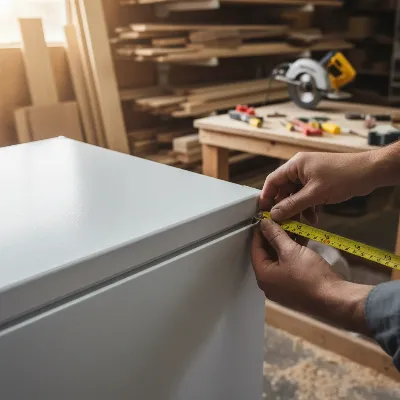 A person meticulously measuring a chest freezer before building a custom wood cabinet to hide it, emphasizing precision.
5. Applying the Finishing Touches
With the main construction complete, it’s time for the finishing touches. Fill any screw holes or imperfections with wood filler and sand all surfaces smooth. Apply a primer, followed by two coats of your chosen paint or stain. If using paint, Johnstones Water Based Satin is a good option. For a natural wood finish, apply a base coat of Osmo Wood Protector and top coats of Osmo Top Oil. Consider adding decorative trim or molding to give the cabinet a more furniture-like appearance. Critically, ensure that any ventilation gaps or holes are clear and unobstructed to maintain optimal freezer performance.
Important Considerations for Functionality and Safety
Building a chest freezer cabinet isn’t just about aesthetics; it’s also about ensuring the freezer operates efficiently and safely within its new enclosure.
- Ventilation is Not Optional: Chest freezers generate heat, primarily from their compressor and coils. Encasing them without adequate airflow will trap this heat, forcing the compressor to work harder, consume more energy, and shorten its lifespan. Always leave generous clearance –
at least 2-3 inches on the sides and back, and some space above the lid– to allow heat to dissipate naturally. Consider incorporating grilles or vents into the cabinet design, especially at the bottom and top, to facilitate convection. - Clearance Beyond Just Airflow: Ensure there’s enough space not only for ventilation but also for cleaning and maintenance. You’ll need to occasionally pull the freezer out for defrosting or to clean dust from the coils.
- Lid Weight and Support are Key: A solid wood lid can be surprisingly heavy. Relying solely on standard hinges can lead to sagging or damage over time. The use of
gas strutsis highly recommended to safely assist in lifting the lid and hold it open securely, preventing accidental closure. This also makes accessing the freezer’s contents much easier and safer. - Stability is Non-Negotiable: The cabinet must be stable and level. Given the weight of a full chest freezer, any wobbling could be a safety hazard. If the cabinet is tall, consider securing it to a wall stud, especially if it’s in a high-traffic area.
- Electrical Access: Always ensure there’s easy and safe access to the freezer’s power outlet. The power cord should not be pinched or strained by the cabinet structure.
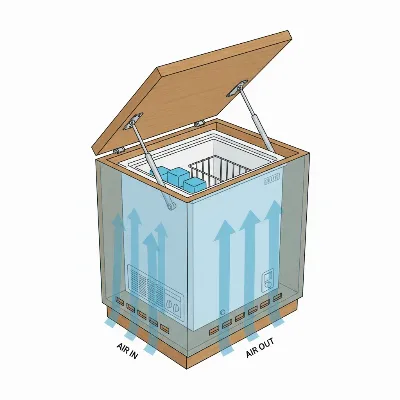 A detailed illustration of a custom wooden chest freezer cabinet, highlighting essential ventilation gaps and gas struts for lid support.
Troubleshooting Common Issues
Even with careful planning, you might encounter minor issues. Here are some common problems and their solutions:
- Cabinet Feels Too Hot: This is almost always due to insufficient ventilation. Double-check your clearances around the freezer. If necessary, add more ventilation openings or grilles, particularly at the back and sides near the bottom and top, to encourage better airflow.
- Lid is Difficult to Open or Close / Doesn’t Stay Open: This points to an issue with your lid mechanism. If using
gas struts, they might be incorrectly adjusted or rated for the wrong weight. Ensure they are properly installed and adjusted. If the hinges are straining, they may not beheavy-duty enoughfor the lid’s weight; consider upgrading them. - Freezer Doesn’t Fit: If the freezer is too snug or doesn’t fit at all, it indicates an error in your initial measurements or construction. Carefully re-measure the freezer and the cabinet’s internal dimensions to identify the discrepancy. In some cases, minor adjustments to the cabinet’s internal framing might be possible, but significant errors may require rebuilding parts of the cabinet.
Conclusion
Transforming your chest freezer from an appliance you’d rather hide into a functional and aesthetically pleasing part of your home is a highly achievable DIY project. By focusing on precise measurements, robust construction, and critical considerations like ventilation and lid support, you can build a custom wood cabinet that seamlessly integrates your freezer into your living space. This not only declutters your home but also adds a personalized touch of craftsmanship. Ready to take on the challenge and improve your home’s functionality and style? What unique design elements will you incorporate to make your chest freezer cabinet truly yours?
Frequently Asked Questions
What kind of wood is best for a chest freezer cabinet?
For structural integrity, planed square edge timber (e.g., 40x40mm) is excellent for the frame. MDF (18mm) or plywood are good choices for panels due to their stability and ease of finishing, while a sturdy worktop or thick plywood is ideal for the lid.
How much space should I leave around a chest freezer for ventilation inside a cabinet?
It’s crucial to leave at least 2-3 inches of clearance on the sides and back, and 4-6 inches above the freezer within the cabinet. This ensures proper airflow, which is essential for the freezer’s efficiency and to prevent overheating.
Are gas struts necessary for a chest freezer cabinet lid?
Yes, gas struts are highly recommended, especially for heavy wooden lids. They assist in lifting the lid, hold it open safely, and prevent excessive strain on your hinges, ensuring smooth and safe operation.
Can I build a cabinet that lets me pull the freezer out?
Absolutely. A common alternative to a hinged lid is to place the freezer on a heavy-duty sliding platform equipped with full extension drawer slides (rated for 250+ pounds). This design works well for freezers positioned under countertops, allowing the appliance to slide out for access.
How do I ensure the cabinet lid also lifts the freezer’s own lid?
You can use Connect Fittings for Integrated Appliance Cabinet Doors. These specialized fittings allow the freezer lid to slide backward as the custom wooden cabinet lid opens, creating a single, integrated lifting motion.
Frequently Asked Questions
What kind of wood is best for a chest freezer cabinet?
For structural integrity, 40x40mm planed square edge timber is excellent for the frame. 18mm MDF or plywood are good choices for panels due to their stability and ease of finishing, while a sturdy worktop or thick plywood is ideal for the lid.
How much space should I leave around a chest freezer for ventilation inside a cabinet?
It's crucial to leave at least 2-3 inches of clearance on the sides and back, and 4-6 inches above the freezer within the cabinet. This ensures proper airflow, which is essential for the freezer's efficiency and to prevent overheating.
Are gas struts necessary for a chest freezer cabinet lid?
Yes, gas struts are highly recommended, especially for heavy wooden lids. They assist in lifting the lid, hold it open safely, and prevent excessive strain on your hinges, ensuring smooth and safe operation.
Can I build a cabinet that lets me pull the freezer out?
Absolutely. A common alternative to a hinged lid is to place the freezer on a heavy-duty sliding platform equipped with full extension drawer slides (rated for 250+ pounds). This design works well for freezers positioned under countertops, allowing the appliance to slide out for access.
How do I ensure the cabinet lid also lifts the freezer's own lid?
You can use Connect Fittings for Integrated Appliance Cabinet Doors. These specialized fittings allow the freezer lid to slide backward as the custom wooden cabinet lid opens, creating a single, integrated lifting motion.
Building a Hinged-Lid Chest Freezer Cabinet
This guide outlines the steps to construct a custom wood cabinet to conceal your chest freezer, enhancing both the look and utility of your room.
Measure your chest freezer's exact dimensions. Add 2-3 inches of clearance on the sides and back, and 4-6 inches above the freezer lid for ventilation. Sketch your design, accounting for material thickness and lid opening.
Cut 40mm x 40mm planed square edge timber for the base, uprights, and top frame. Assemble using wood screws and strong wood glue, ensuring all joints are perfectly square with a carpenter's square. This framework supports the panels and heavy lid.
Cut 18mm MDF or plywood panels to fit the frame. Secure them with wood glue and screws or nails, drilling pilot holes to prevent splitting. For the back panel, ensure airflow by leaving a gap or drilling holes.
Cut your lid material, such as a 40mm white oak worktop, to size with a slight overhang. Attach heavy-duty hinges to the cabinet frame and lid. Install Connect Fittings for Integrated Appliance Cabinet Doors if you want the cabinet lid to lift the freezer's lid simultaneously. Install 700N adjustable force gas struts, routing slots or widening the cabinet by 60mm to accommodate them, then attach a sturdy handle.
Fill screw holes with wood filler and sand all surfaces smooth. Apply primer, then two coats of paint (e.g., Johnstone's Water Based Satin) or wood stain and top oil (e.g., Osmo Wood Protector and Osmo Top Oil). Ensure all ventilation gaps remain clear.

The idea of hiding my chest freezer was appealing, and the guide had some good points. However, I found the 18mm MDF for panels a bit heavy to work with on my own. It would have been helpful to have a suggestion for a lighter alternative for those of us with less muscle. The end result is good, but the build was a bit of a struggle.
Fantastic guide! I’ve been wanting to do this for ages but wasn’t sure where to start. The emphasis on precise measurements really paid off, everything fit together perfectly. My freezer is now seamlessly integrated into my utility room and it looks fantastic. No more ugly white box!
This DIY project was exactly what I needed. I was worried about ventilation, but the detailed instructions on leaving 2-3 inches of clearance on the sides and back, plus 4-6 inches above the lid, put my mind at ease. My freezer is running perfectly and it looks so much better in the pantry now. Definitely recommend giving this a try if you’re handy.
I’m so glad I found this guide! My chest freezer was such an eyesore in the garage, and I really wanted to integrate it better. The tip about using 40mm x 40mm planed square edge timber for the frame was super helpful, made it really sturdy. Now it looks like a custom piece of furniture and I even gained some extra counter space.