Small chest freezers are an ideal solution for apartment dwellers seeking expanded frozen food capacity without sacrificing living space. These compact units typically range from 2.0 to 5.3 cubic feet, offering sufficient storage for 70 to 185 pounds of food, and are notably energy-efficient, often consuming 10-20% less power than larger, automatic defrost models. Their design maximizes storage in minimal footprints, making them perfect for urban living.
This comprehensive guide, drawing on over a decade of hands-on experience, will help you navigate the options. We’ll highlight the key features, advantages, and even the minor trade-offs, along with showcasing top models to help you make an informed decision when selecting the perfect chest freezer for your apartment.
Advantages of Small Chest Freezers for Apartments
Small chest freezers offer compelling benefits that make them particularly attractive for apartment living. They are often overlooked but provide a delightful blend of practicality and efficiency.
One significant advantage is their energy efficiency. These compact units typically consume less power compared to larger models, which can lead to noticeable savings on your utility bills over time. Specifically, manual defrost models are known to be 10-20% more energy-efficient than their automatic, frost-free counterparts, making them a cost-effective choice for long-term use.
Their space-saving design is another critical factor. Small chest freezers are built with compact footprints, often averaging between 30 to 36 inches long and 20 to 24 inches wide. This allows them to fit snugly into tight spaces like kitchen corners, pantries, or even a discreet spot in a living area without overwhelming the room.
Chest freezers are also renowned for their excellent cold retention capabilities. Their top-opening design means that cold air, which is denser than warm air, stays inside the unit when the lid is opened, minimizing temperature fluctuations. Many models even offer impressive power outage protection, keeping food frozen for up to 48 hours, a reassuring safeguard against spoilage. Beyond efficiency, small chest freezers are often more cost-effective upfront compared to upright freezers, offering a budget-friendly entry into expanded frozen storage.
Lastly, despite their compact external dimensions, they boast generous bulk storage capacity. Their deep, open interior provides significant usable space, ideal for storing bulk purchases, large cuts of meat, or prepped meals, truly amplifying your food storage options.
Disadvantages of Small Chest Freezers
While small chest freezers bring numerous benefits to apartment living, it’s essential to consider their potential downsides to ensure they align with your lifestyle and space.
The most obvious disadvantage is the physical footprint they require. Even “small” chest freezers take up dedicated floor space, which can be a premium in already constrained apartment layouts. Unlike upright freezers that offer vertical storage, chest freezers demand horizontal room, making precise measurements crucial before purchase.
Organization can also be a challenge. Chest freezers typically feature less built-in shelving or compartments compared to upright models. This deep, open cavity, while excellent for bulk items, can make it harder to organize smaller items or access foods buried at the bottom without proper management using removable baskets.
Finally, for the sake of energy efficiency, most small chest freezers require manual defrosting. This means you’ll need to periodically empty the freezer, turn it off, and allow the accumulated ice to melt. While not an everyday task, it can be a chore for some users, although many models now include accessible drain plugs to simplify the process.
Key Features to Consider When Choosing a Small Chest Freezer
|
Our Picks for the Best Chest Freezer in 2026
As an Amazon Associate I earn from qualifying purchases.
|
||
| Num | Product | Action |
|---|---|---|
| 1 | Chest Freezer Small Deep Freezer 3.5 Cu.Ft Mini Freezer with Removable Baskets & 6 Adjustable Temperature (Down to -11°F)& Top Open Door, Mini Compact Freezer Suitable for Apartments, Kitchen, White |

|
| 2 | Commercial Solid Top Chest Freezer by Atosa |
|
| 3 | Koolatron Deep Freezer - 3.5 Cubic Feet, White Chest Freezer, 1 Wire Basket, Garage Ready, Meat Storage, Front Drain, Congelador For Home, Apartment, Basement, Dorm, Cottage, Manual Defrost, Stand Up |
|
| 4 | Koolatron 1.2 Cubic Feet Capacity White Upright freezer - 1 wired shelf, Garage Ready, Meat Storage, Manual Defrost, Space Saving, Congelador For Home, Apartment, Basement, Dorm, Room |
|
| 5 | Avanti Upright Freezer Compact Design with 3 Fixed Metal Shelves, Reversible Door Adjustable Temperature Control and Flush-Back Design Perfect for Home, Office, Basements & More, 2.8-Cu.Ft, White |
|
| 6 | Whynter Upright Small Freezer Mini Freezer with Lock for Bedrooms, Dorms, Garages, Offices CUF-110B, Black Energy Star, 1.1 Cu Ft |
|
| 7 | SPT UF-114W Upright Freezer, White, 1.1 Cubic Feet |
|
| 8 | BLACK+DECKER 1.2 Cu. Ft. Compact Upright Freezer, Mini Deep Freeze with Full-Width Wire Shelf |
|
| 9 | 2 Pack Refrigerator Thermometer, 30-30°C/20-80°F, Classic Fridge Thermometer Large Dial with Red Indicator Thermometer for Freezer Refrigerator Cooler |
|
| 10 | BESTYASH Freezer Organizer Divider Adjustable Chest Freezer Organizer with Breathable Layered Mesh for Refrigerator and Freezer Food and Beverage Storage 15.9X15.9X12.6 Inches |
|
Selecting the right small chest freezer involves more than just picking the smallest option. Thoughtful consideration of key features will ensure your new appliance perfectly complements your apartment living and freezing needs.
First and foremost, assess size and capacity. Compact chest freezers typically range from 2.0 to 5.3 cubic feet, capable of holding approximately 70 to 185 pounds of food. A good rule of thumb is to allow for roughly 2.5 cubic feet of storage per person in your household. However, always measure your available space—length, width, and height—meticulously, including door clearances, to ensure the unit will fit comfortably in its intended spot and can be easily moved into your apartment.
Energy efficiency is paramount for any appliance running 24/7. Look for models with a low annual kilowatt-hour (kWh) usage and, ideally, an Energy Star certification, which signifies that the freezer meets or exceeds the EPA’s efficiency standards. This directly translates to lower running costs and a lighter environmental footprint.
Temperature control should be precise. While many basic models feature mechanical exterior dials, some advanced units offer digital displays for exact temperature adjustments. Exterior controls are particularly convenient as they allow you to modify settings without opening the lid and releasing cold air. For apartment living, noise level is a critical, often overlooked, factor. Seek out models that operate quietly, ideally below 40 decibels, to avoid disturbing your living environment.
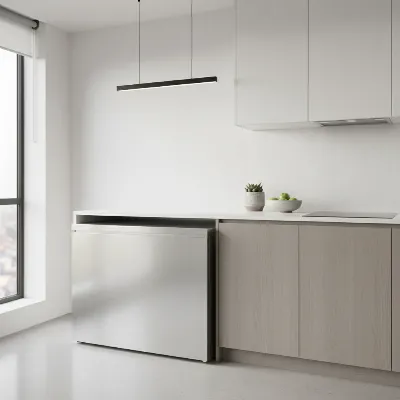 A compact chest freezer in a modern apartment kitchen, blending seamlessly with stainless steel appliances.
Interior organization is key to making the most of a chest freezer’s deep space. Removable storage baskets are essential for keeping smaller items visible and easily accessible, preventing a “bottomless pit” scenario. Pay attention to the lid design; counterbalanced or “stay-open” hinges that can hold the lid at various angles (e.g., 45-90 degrees) are incredibly convenient for hands-free loading and unloading.
Regarding defrosting, most energy-efficient small chest freezers use manual defrost. While it requires periodic attention, look for models with an easily accessible drain plug to simplify the process. Some modern freezers offer convertible functionality, allowing them to switch between freezer and refrigerator modes, adding a layer of versatility. Lastly, consider aesthetics; while many chest freezers are basic white, some manufacturers offer stainless-steel-like finishes that can blend seamlessly with modern kitchen appliances.
Top Small Chest Freezer Models for Apartments in 2026
Based on their compact size, efficiency, and features suitable for apartment living, several models stand out in 2026.
Midea 3.5-Cubic-Foot Mini Freezer Chest: This model consistently earns praise as a “best value” option. It offers a versatile convertible design, allowing it to function as either a freezer or a refrigerator, which is incredibly useful for adapting to changing storage needs. It also provides impressive 48-hour power outage protection, a crucial safeguard for food preservation. Despite its compact footprint (21.5 x 33.5 x 17.6 inches), it is garage-ready and features adjustable legs for uneven floors, a removable basket for organization, and convenient exterior controls. Its energy consumption is rated at 193 kWh/year.
BLACK+DECKER 2.0 Cu. Ft. Compact Chest Freezer: Considered one of the “most compact” options, this model is ideal for singles or apartment dwellers with very limited space. It can hold up to 70 pounds of food within its minimal dimensions (20.9 x 27.2 x 17.3 inches). Despite its small size, it offers seven different temperature settings and includes a removable storage basket. It features a manual defrost function with an accessible drain, and its annual energy use is a low 170 kWh. While not garage-ready, its compact nature makes it perfectly suited for indoor apartment placement.
Lifeplus 3.5 Cubic Feet Chest Freezer: Labeled as “best for kitchens,” this Lifeplus model distinguishes itself with a sleek stainless-steel-like finish, a rarity among chest freezers, allowing it to blend seamlessly with modern kitchen decor. Its compact footprint (22.4 x 29.3 x 18.5 inches) and adjustable legs enable it to align neatly with countertops. This unit is remarkably quiet, running below 40 decibels, making it perfect for open-plan living spaces. It’s also highly energy-efficient, drawing just 0.37 kWh per day (approximately 135 kWh/year). Additional features include a 7-mode thermostat, a lid that stays open at any angle up to 90 degrees, and a removable basket.
Northair 3.5-Cubic-Foot Chest Freezer: This compact freezer is frequently recommended for small kitchens due to its narrow width (barely over 21 inches wide). It excels in temperature control, featuring an adjustable thermostat located on the exterior that can set temperatures as low as -40 degrees Fahrenheit, making it suitable for specialized freezing needs. It includes two hanging wire baskets to maximize organization and a hinged lid that remains open for hands-free access.
Tips for Effective Use and Maintenance
To get the most out of your small chest freezer and ensure its longevity, consider these practical tips for effective use and maintenance.
Strategic Placement is crucial for optimal performance and efficiency. Choose a cool, well-ventilated spot away from direct sunlight or heat sources like ovens and radiators. Ensure there is at least 1-3 inches of clearance around all sides of the freezer to allow for proper airflow and prevent overheating.
Organize with Baskets to maximize space and ensure easy access to your frozen items. Since chest freezers have a deep cavity, removable wire baskets are invaluable for sorting smaller items and keeping frequently used foods near the top, preventing them from getting lost at the bottom.
It’s important to avoid overloading or underfilling your freezer. While it’s tempting to pack it to the brim, overfilling can restrict airflow, making the freezer work harder. Conversely, leaving too much empty space can be less energy-efficient as the freezer has to cool more air rather than dense frozen goods. Aim to keep it relatively full for optimal efficiency.
For manual defrost models, regular defrosting is necessary to maintain efficiency. Defrost the unit when frost buildup reaches about 1/4 inch thick. This buildup acts as an insulator, reducing cooling efficiency. Utilize the accessible drain plug to make the defrosting process easier. Always ensure the lid gasket is clean and sealing tightly to prevent cold air from escaping, which can lead to frost buildup and increased energy consumption. Periodically check the seal for any cracks or damage.
Finally, monitor the temperature if your freezer doesn’t have an accurate built-in thermometer. An inexpensive external freezer thermometer can help ensure your food is consistently stored at the ideal temperature (0°F or -18°C) for safety and quality.
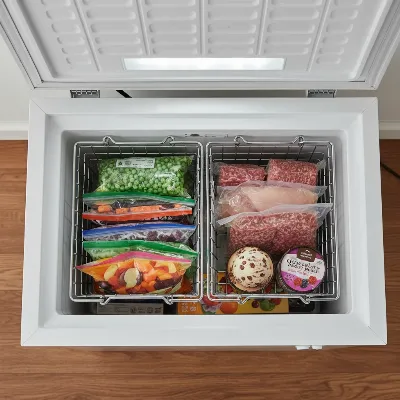 The interior of a small chest freezer, neatly organized with various frozen foods in removable baskets.
Common Issues and Troubleshooting
Even the best small chest freezers can encounter minor issues. Knowing how to troubleshoot common problems can save you time and potential repair costs.
If your freezer is not cooling properly, first check the basics: ensure it’s securely plugged into a working outlet and that the circuit breaker hasn’t tripped. Next, verify the thermostat settings, making sure it’s set to a sufficiently cold temperature. Also, confirm that there’s proper ventilation around the unit; insufficient airflow can hinder its cooling performance.
Excessive frost buildup is a frequent complaint, especially with manual defrost models. This typically indicates an air leak, often due to a faulty or dirty door gasket that isn’t sealing tightly. Clean the gasket thoroughly and check for any cracks or damage. If the seal is compromised, it may need to be replaced. Excessive frost also signals that it’s time for a manual defrosting cycle.
If your freezer is making unusual or loud noises, it could be a few things. A constant humming or clicking is often the normal sound of the compressor cycling on and off. However, if you hear rattling, vibrating, or grinding, first ensure the freezer is level on the floor and not touching any walls or other objects that could be vibrating. Check for loose items inside the freezer. Persistent loud noises could indicate an issue with the compressor or condenser fan, which might require professional attention.
Conclusion
Small chest freezers are an invaluable addition to apartment living, providing significant extra storage capacity, impressive energy efficiency, and reliable performance in a compact form factor. They empower apartment dwellers to take advantage of bulk discounts, prepare meals in advance, and store seasonal produce, all without consuming excessive space or spiking utility bills.
When selecting your ideal small chest freezer, prioritize factors such as the appropriate capacity for your household, its energy efficiency rating, a low noise level for a peaceful apartment environment, and practical organization features like removable baskets. Choosing a model with a stay-open lid and convenient temperature controls can also greatly enhance your user experience. With the right choice, a small chest freezer will seamlessly integrate into your home, offering a treasure trove of frozen goods. What frozen treasures will you stock first in your new compact chest freezer?
Frequently Asked Questions
What is a good size for a chest freezer in an apartment?
For apartment living, a chest freezer between 2.0 to 5.3 cubic feet is generally considered a good size. This range offers enough capacity for an individual or a small household’s bulk storage needs without taking up too much floor space, often capable of holding 70 to 185 pounds of food.
Are small chest freezers energy efficient?
Yes, small chest freezers are typically very energy-efficient, often consuming less power than larger models. Manual defrost chest freezers, in particular, can be 10-20% more energy-efficient than automatic defrost units. Look for models with low annual kWh ratings and Energy Star certification for the best efficiency.
Where is the best place to put a chest freezer in an apartment?
The best place to put a chest freezer in an apartment is a cool, well-ventilated area away from direct sunlight or heat sources. Good locations include a pantry, a utility closet, a corner of the kitchen, or even a discreet spot in a living area. Ensure 1-3 inches of clearance around all sides for proper airflow.
How do I organize a small chest freezer?
Organizing a small chest freezer is best done using removable storage baskets. These baskets allow you to group similar items and easily lift them out to access foods stored underneath. Labeling baskets and the items within them can also significantly improve organization and reduce rummaging.
Do small chest freezers need manual defrosting?
Most small, energy-efficient chest freezers require manual defrosting. This means you will need to periodically turn off the unit and allow any ice buildup to melt. This process helps maintain the freezer’s efficiency. Many models include a convenient drain plug to simplify the defrosting process.
Frequently Asked Questions
What is a good size for a chest freezer in an apartment?
For apartment living, a chest freezer between 2.0 to 5.3 cubic feet is generally considered a good size. This range offers enough capacity for an individual or a small household's bulk storage needs without taking up too much floor space, often capable of holding 70 to 185 pounds of food.
Are small chest freezers energy efficient?
Yes, small chest freezers are typically very energy-efficient, often consuming less power than larger models. Manual defrost chest freezers, in particular, can be 10-20% more energy-efficient than automatic defrost units. Look for models with low annual kWh ratings and Energy Star certification for the best efficiency.
Where is the best place to put a chest freezer in an apartment?
The best place to put a chest freezer in an apartment is a cool, well-ventilated area away from direct sunlight or heat sources. Good locations include a pantry, a utility closet, a corner of the kitchen, or even a discreet spot in a living area. Ensure 1-3 inches of clearance around all sides for proper airflow.
How do I organize a small chest freezer effectively?
Organizing a small chest freezer is best done using removable storage baskets. These baskets allow you to group similar items and easily lift them out to access foods stored underneath. Labeling baskets and the items within them can also significantly improve organization and reduce rummaging.
Do small chest freezers need manual defrosting?
Most small, energy-efficient chest freezers require manual defrosting. This means you will need to periodically turn off the unit and allow any ice buildup to melt. This process helps maintain the freezer's efficiency. Many models include a convenient drain plug to simplify the defrosting process.

This guide was super helpful in narrowing down my options. I ended up with a 5.3 cubic foot unit, and it’s been great for storing all my hunting game. The energy efficiency was a big selling point for me, and I haven’t noticed any significant jump in my electricity bill. My only minor complaint is that the manual defrost can be a bit of a chore, but it’s not a dealbreaker.
As someone who loves to cook and freeze leftovers, a small chest freezer was essential. I picked one up that holds around 100 pounds of food, and it’s been fantastic. It’s so quiet, I barely even notice it’s there. The compact footprint really is ideal for my small living room, and it’s freed up so much space in my regular fridge freezer.
I bought a compact freezer after reading about the benefits for apartment living. While it does save space and holds a decent amount for its size, I was a little disappointed with the internal organization. It’s basically just a big bin, and things can get lost at the bottom. I wish it came with more baskets or dividers to make it easier to find smaller items without digging everything out.
I’m so glad I finally pulled the trigger on a small chest freezer! Living in a tiny apartment, I was worried about space, but the 3.5 cubic foot model I got fits perfectly in a corner of my kitchen. It’s amazing how much more food I can store now, especially with bulk buys. Definitely a game-changer for meal prepping and saving money.